

Ask ten event planners which they prefer — a restroom trailer or a portable toilet — and you will hear ten different answers, most of them based on price. That instinct costs organizers real money. A restroom trailer delivers running water, lighting, climate control, and a guest experience closer to a hotel bathroom, while a portable toilet offers a bare, chemical unit at a fraction of the cost. The right choice depends on your event type, your guest count, your site access, and the impression you want to leave. Moreover, the gap between the two has widened as restroom trailers moved from luxury weddings into festivals, construction sites, and corporate events.
This guide compares restroom trailers and portable toilets across comfort, hygiene, capacity, mobility, and total cost, and it shows exactly when each option earns its keep. By the end, you will know which unit fits your event — and what to ask before you buy or rent.
What actually differs
A portable toilet is a single, self-contained unit: a chemical toilet over a holding tank, usually without running water, lighting, or climate control — a category the portable toilet overview describes in detail. A restroom trailer, in contrast, is a towable unit with real bathrooms inside: private stalls, flushing toilets, sinks with running water and soap, mirrors, paper towels, and waste bins. Premium models add air conditioning or heating, lighting, and luxury finishes. In short, a portable toilet solves a basic need; a restroom trailer delivers an experience.
The mechanical differences follow. Trailers carry their own fresh water and waste tanks, connect to municipal water when available, and ride on a chassis with axles and tires for towing. As a result, a restroom trailer needs a truck to move and space to park, while a portable toilet fits in the back of a van and sits almost anywhere.
Restroom trailer vs. portable toilet: side-by-side
The table below summarizes how the two formats compare across the factors that matter most to organizers and site managers.
| Factor | Portable Toilet | Restroom Trailer |
|---|---|---|
| Comfort | Basic, standing room only | Private stalls, seats, interior space |
| Running water | Rarely | Sinks with running water and soap |
| Flushing system | Chemical, tank-based | Flushing toilets with fresh and grey water tanks |
| Lighting and climate | None or minimal | Lighting; AC and heating in premium models |
| Capacity per unit | One person at a time | Multiple stalls (2-stall models common) |
| Setup | Drop in place | Level the unit, connect water and power, tow vehicle required |
| Cost | Low | Higher, but higher perceived value |
| Best for | Budget, short events, remote sites | Weddings, corporate events, long-term sites |
The cost reality: price tags and hidden costs
The headline numbers differ by an order of magnitude: renting portable toilets costs a fraction of renting a restroom trailer, and buying a portable toilet costs a fraction of buying a trailer. Consequently, the comparison does not end at the sticker price. A restroom trailer brings running water, which means you pay for water, power, and often a service crew; a portable toilet needs regular pumping and cleaning, which also adds up over a busy season.
Hidden costs tilt the decision either way. Transport: trailers need a tow vehicle and careful placement on level ground. Servicing: chemical units require frequent pump-outs at high-traffic events, while trailers with 750-liter tanks handle longer shifts. Compliance: OSHA requires employers to provide sanitary, immediately available toilet facilities on worksites, and public events increasingly need accessible units that meet the ADA Standards for Accessible Design. Weigh these costs together before you compare daily rates.
When a portable toilet wins
The portable toilet still leads in five situations:
- Tight budgets. For a one-day community event, several portable toilets cost less than a single trailer rental.
- Remote or off-grid sites. No water, no power, no level ground: a chemical unit works anywhere you can drive a van.
- Large crowd counts. Events with thousands of guests scale portable toilets quickly; trailers cap out at a few stalls.
- Emergency and short-term needs. Disaster relief and temporary housing value speed and simplicity.
- Low-expectation venues. Backcountry trails, fishing camps, and rustic events fit a basic unit perfectly.
When a restroom trailer wins
The restroom trailer earns its higher price in these scenarios:
- Weddings and corporate events. Guests remember the bathroom; a luxury restroom trailer protects the brand of the event.
- Construction sites. OSHA rules demand sanitary facilities for workers, and a trailer adds washing stations that improve hygiene and morale.
- ADA and family needs. Accessible models meet the ADA Standards for Accessible Design, and gender-separated stalls serve families comfortably.
- Long-term placements. At multi-week projects, running water and climate control keep facilities clean and usable.
- Weather extremes. Air conditioning and heating keep guests comfortable at summer festivals and winter events alike.
What Weikeer builds
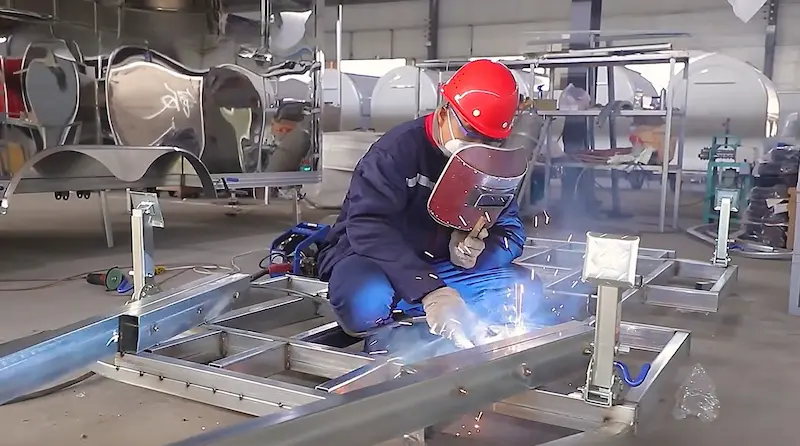
Shandong Weikeer Intelligent Manufacturing builds both sides of this comparison. The 2-stall luxury mobile restroom trailer (T3-3) offers private stalls, stainless steel 750-liter fresh and grey water tanks, two axles, and an optional municipal water connection; the eco-friendly restroom trailer (MTL-001-009) adds sustainable materials and waste management. On the other side, the luxury ready-made portable public toilet (T8-1) covers budget and remote-site needs. Moreover, every unit ships with OEM/ODM branding, a one-year warranty, and online technical support.
Because Weikeer sells factory-direct from its plant in Weifang, China, with global delivery, you buy the same steel and labor at manufacturer prices — no dealer markup. Tell us your event type, guest count, and site conditions, and the design team recommends the right model and configuration. Browse the full trailer lineup or read the toilet trailer guide for events and construction sites for more detail.
FAQ
Q1. What is the main difference between a restroom trailer and a portable toilet? A portable toilet is a single self-contained chemical unit without running water. A restroom trailer is a towable unit with private stalls, flushing toilets, sinks with running water, lighting, and often climate control — closer to a real bathroom.
Q2. Are restroom trailers more expensive than portable toilets? Yes, both to rent and to buy. The gap narrows once you count servicing, transport, and compliance: trailers with 750-liter tanks need fewer pump-outs, and premium events often justify the higher cost with guest satisfaction.
Q3. Do restroom trailers need water and power hookups? Not necessarily. Weikeer trailers carry stainless steel fresh and grey water tanks and can connect to municipal water when available. Power runs from a generator or site hookup depending on the configuration.
Q4. Which option meets OSHA and ADA requirements? Construction sites must provide sanitary toilet facilities under OSHA rules. For accessibility, choose units that meet the ADA Standards for Accessible Design. Weikeer offers ADA-compliant configurations and gender-separated stalls on request.
Q5. How do I choose the right model for my event? Match capacity to guest count, decide between standard and luxury finishes, and check water and power availability at the site. Send Weikeer your event details and we recommend a model and configuration with a quotation.
Final thought
The restroom trailer vs. portable toilet decision comes down to expectations: do you need to solve a basic need, or do you want to impress the people using it? Portable toilets win on price and simplicity; restroom trailers win on comfort, hygiene, and brand image. Moreover, the market has shifted — guests at modern events expect more than a plastic booth, and organizers who deliver better facilities see better reviews, happier workers, and repeat bookings.
Ready to upgrade your event or job site? Contact Weikeer today and get a free recommendation and quotation for your restroom trailer.