

Walk past a typical food stall and you glance at the menu. Walk past a boat food trailer and you stop for the photo. That difference in attention translates directly into sales, and it explains why boat-shaped food trailers keep appearing at festivals, beaches, and city markets. The U.S. food truck industry is projected to reach $2.9 billion in revenue by 2026, growing 3.4% annually over the five years prior (IBISWorld, 2026). In that crowded market, the operator who looks different wins the first sale — and the boat food trailer delivers that advantage before you serve a single dish.
This guide explains what makes a quality boat food trailer, how it compares with a standard food trailer, what it really costs, and how factory-direct customization from Weikeer turns your menu into a street kitchen customers remember.
The silent marketing power of a curved hull
The food industry sells experience as much as food. A boat food trailer brings that experience in its silhouette: rounded hull lines, a curved serving window, and nautical details that read instantly as “something different”. Social media amplifies the effect — distinctive units generate photos, tags, and word-of-mouth that paid advertising cannot buy. For a modest design investment, your trailer becomes the landmark people describe to friends.
Practical advantages follow the visual ones. The curved body deflects wind better than flat panels, rounded corners reduce pinch points in crowded events, and the compact footprint fits tight festival plots. Moreover, the boat theme fits food categories naturally: seafood, ice cream, coffee, juice, and beachside snacks all gain credibility from the maritime look. As a result, one distinctive build supports both brand recall and menu storytelling.
What you actually get inside a quality build
A boat food trailer works as a full commercial kitchen on wheels, not a decorated shell. Weikeer’s QB-TZ-1 model, for example, includes a stainless steel and iron sheet frame, fiberglass and aluminum body panels, rust-resistant construction, non-slip aluminum flooring with drainage, a hand-wash sink, and a built-in electrical system with sockets, breaker, and light tubes. Power options cover 110 V, 220 V, or 380 V to match your market, and the 750 kg towable unit runs on four wheels with cooking equipment tailored to your menu: burner stoves, flat-top grills, steam tables, refrigerators, beverage dispensers, or ice cream machines. A one-year warranty backs the build.
Boat food trailer vs. standard food trailer: what changes
Compared with a conventional rectangular trailer, the boat food trailer shifts a few practical factors. The table below summarizes the differences that matter when you plan your business. Figures reflect typical market observations; exact pricing depends on size, equipment, and customization level.
| Factor | Standard Food Trailer | Boat Food Trailer |
|---|---|---|
Visual appeal |
Familiar, utilitarian | Distinctive, photo-worthy |
Customer attention |
Depends on signage | Built into the silhouette |
Menu fit |
Any cuisine | Strong for seafood, ice cream, coffee, juice |
Interior layout |
Straight walls, easy shelving | Curved walls — custom layout required |
Footprint |
Standard | Compact, fits tight festival plots |
Construction cost |
Lower baseline | Slightly higher for curved panels |
Brand recall |
Moderate | High |
Resale value |
Standard market | Niche buyers pay for the look |
The cost picture: what you pay and what you save
A custom boat food trailer typically costs 18,000–18,000–60,000 depending on size, equipment, and finish — comparable to a standard custom food trailer, with a modest premium for the curved bodywork. The savings arrive on the operating side. A trailer carries no engine, so you avoid drivetrain maintenance, commercial vehicle registration in many states, and the higher insurance premiums that motorized food trucks attract.
Hidden costs deserve attention too: a tow vehicle rated for the load — the QB-TZ-1 weighs roughly 750 kg (about 1,650 lb) empty, so a mid-size pickup or SUV with an adequate tow rating handles it — plus event fees, generator fuel or shore-power hookups, and local health permits modeled on the FDA Food Code. Moreover, storage stays simple because the unit unhooks and parks in a driveway or lot. Add these up and a boat food trailer often reaches break-even faster than a comparable food truck: the build costs less, and the curiosity factor drives early sales.
Where boat food trailers win the most
The format earns its keep in five settings:
- Festivals and events. Organizers assign plots by footprint; the compact boat shape fits, and the distinctive look pulls lines past neighboring stalls.
- Beaches and waterfronts. The nautical theme belongs there; ice cream, seafood, and cold drinks sell naturally.
- Campuses and high-traffic streets. Curiosity converts passersby into buyers, and the unit doubles as a moving billboard.
- Ice cream and coffee concepts. The QB-TZ-1 ships ready for soft-serve machines, espresso bars, and beverage dispensers — see the custom boat food trailer and the multi-cuisine street kitchen variants.
- Multi-cuisine menus. Hot fast food through one window and cold drinks through another keeps queues moving.
Design your own: how factory-direct customization works
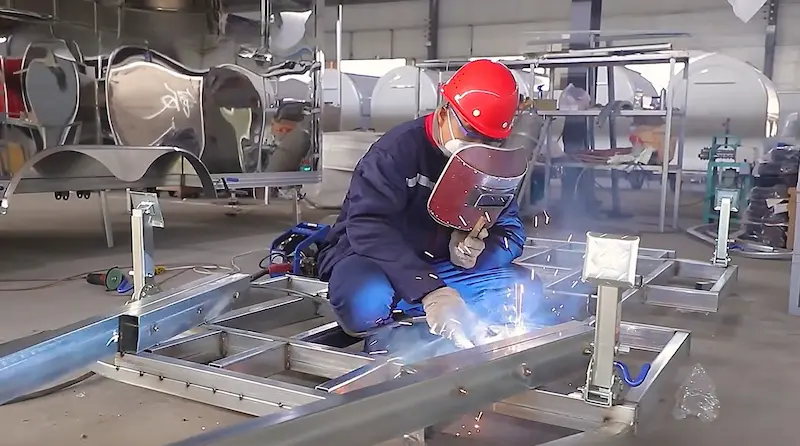
The real power of a boat food trailer comes from customization. Shandong Weikeer Intelligent Manufacturing builds each unit to order in its factory in Weifang, Shandong, with OEM/ODM branding — your logo, your colors, your menu-driven equipment list. The design team drafts the interior layout before production, and you approve drawings, materials, and equipment specs in advance. Video inspection before shipping shows you the finished unit, and global delivery brings it to your market with after-sales support.
This factory-direct model removes the dealer markup, so you pay for steel, fiberglass, and labor. Consequently, a fully equipped custom boat food trailer often costs less than a stock unit from a local dealer. Browse the full food trailer lineup in our shop, or send your menu and budget for a layout proposal.
FAQ
Q1. What is a boat food trailer?
A boat food trailer is a towable mobile kitchen shaped like a boat hull, built for street food, events, and seasonal locations. Weikeer’s QB-TZ-1 includes a stainless steel frame, fiberglass body, non-slip flooring, built-in power, and customized cooking equipment.
Q2. How much does a custom boat food trailer cost?
A custom boat food trailer typically costs 18,000–18,000–60,000 depending on size, equipment, and finish. Factory-direct builds remove the dealer markup, and the unit avoids engine and drivetrain costs, so total ownership costs stay lower than a food truck’s.
Q3. Do I need a special license to operate one?
It depends on your state and the trailer’s weight. Most light-duty trailers require only trailer registration and a standard license. Check your local Department of Motor Vehicles and the Association of Food and Drug Officials’ mobile food establishment guidance for state-specific rules; health inspections follow the FDA Food Code.
Q4. Can I customize the interior and branding?
Yes, fully. Weikeer offers 100% customizable layouts, equipment, colors, and OEM/ODM branding. You approve the drawings before production, and video inspection confirms the finished unit before shipping.
Q5. Which foods sell best from a boat food trailer?
Seafood, ice cream, coffee, juice, and beachside snacks fit the theme naturally, but operators run burgers, smoothies, desserts, and multi-cuisine menus successfully. The curved layout suits menus with one or two signature items plus drinks.
Final thought
The street food market rewards operators who stand out. A boat food trailer combines a working commercial kitchen with a visual identity that generates attention, photos, and repeat visits — the ingredients of an unforgettable business. Moreover, factory-direct customization keeps the price honest, and the towable format keeps your options open: change location, change season, change menu, all with the same asset.
Ready to design your boat food trailer? Contact Weikeer today and receive a free layout proposal and quotation.