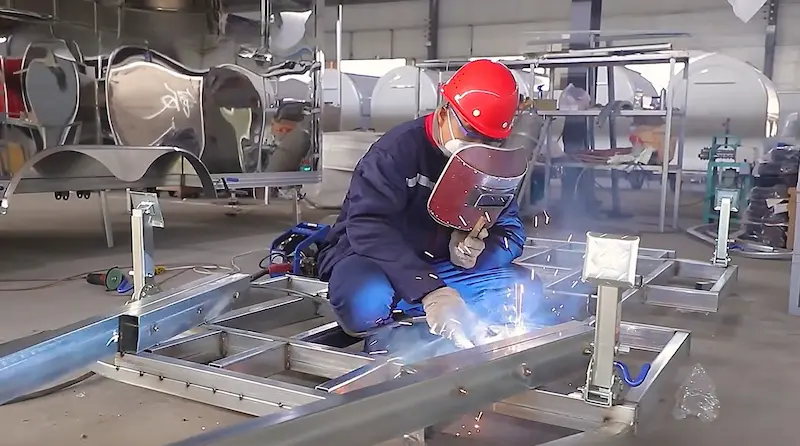


For many years, food trailers and food trucks have relied heavily on propane tanks and gasoline or diesel generators to power their kitchens. But with the rapid rise of renewable energy, battery technology, and quieter electric systems, more mobile food entrepreneurs are asking a new question: Can a food trailer be completely electric?
Surprisingly, the answer is yes — under the right conditions. While not every concept is suited for an all-electric setup, the idea is increasingly realistic and offers significant advantages. Let’s explore what it means for a food trailer to be all electric, when it works best, and what applications suit it most.
What Does “All Electric” Really Mean?
An all-electric food trailer runs 100% without propane or fuel-powered generators. Instead, it relies on one or more of the following:
- High-capacity lithium battery banks
- Inverters capable of powering kitchen appliances
- Shore power (plug-in power at events or commissary kitchens)
- Solar panels as a supplemental charging source
- Energy-efficient electric cooking equipment
In other words, heat, refrigeration, lighting, and electronics are all powered by electricity alone.
Is It Technically Possible?
Yes — but feasibility depends on two factors:
1. Total Electrical Load
Some appliances consume a large amount of power. For example:
- Electric griddles: 3,000–5,000 W
- Electric fryers: 4,000–8,000 W
- Espresso machines: 1,800–3,000 W
- Refrigerators: 150–400 W
- Ventilation fans: 100–300 W
A fully electric setup must have enough stored energy and real-time power output to run everything safely.
2. Battery & Inverter Capacity
Modern lithium (LiFePO₄) batteries paired with high-output inverters can support many mobile kitchens. Systems ranging from 10 kWh to 30 kWh are increasingly common in electric food trailers, especially those designed for cafés or dessert concepts.
When Does an All-Electric Food Trailer Work Best?
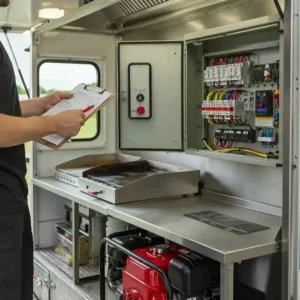
Some concepts are extremely well-suited for all-electric power:
Coffee Trailers
Coffee machines, grinders, fridges, and POS systems run perfectly on electricity. Many new mobile cafés operate fully electric for quiet and eco-friendly service.
Beverage & Smoothie Trailers
Blenders, coolers, and undercounter refrigerators have relatively low power demands.
Dessert & Ice Cream Trailers
Waffle makers, freezers, and warmers can be efficiently powered—especially with shore power availability.
Prepackaged Food or Light-Prep Kiosks
Minimal cooking means minimal electrical load.
When Is an All-Electric Trailer More Challenging?
Heavy-cooking food concepts may struggle:
High-volume frying (fried chicken, fries)
Electric fryers demand enormous wattage.
Large griddles or charbroilers
Sustained high heat drains batteries quickly.
Multi-appliance hot kitchens
Electric-only systems become costly and require very large battery banks.
For these concepts, hybrid systems (propane + electric) remain the most practical.
Advantages of an All-Electric Food Trailer
Going fully electric offers several compelling benefits:
Ultra Quiet Operation
No generator noise—ideal for urban areas, events, and residential zones.
Eco-Friendly
Zero propane emissions and lower carbon output (especially with solar charging).
Lower Operating Costs
Electricity, when purchased from shore power or solar, is significantly cheaper than gasoline.
Safer Work Environment
No open flames, no propane leaks, and simpler fire suppression requirements.
Low Maintenance
Electric systems require less upkeep than generators or gas lines.
Potential Drawbacks
A fully electric food trailer also comes with limitations:
Higher Upfront Cost
Lithium battery systems and inverters represent a major initial investment.
Limited Run Time
High-power cooking will deplete batteries faster unless you have reliable shore power.
Solar Is Not Enough Alone
Solar panels are great for topping up, but insufficient for full-time cooking needs.
So, Can a Food Trailer Be All Electric?
Yes — absolutely.
All-electric food trailers are practical, efficient, and increasingly popular, especially for:
- Coffee trailers
- Beverage concepts
- Bakery & dessert trailers
- Light-prep menus
- Environments requiring quiet operation
For high-heat cooking, a hybrid system may still be the most efficient solution — but the future is clearly trending toward cleaner, quieter electric power.
Should You Choose an All-Electric Setup?
If your menu is electricity-friendly and you want a modern, eco-conscious, low-noise trailer, an all-electric configuration could be a perfect fit. Not only does it future-proof your business, but it also opens doors to events that restrict propane and generator noise.
As technology advances, we may soon see many more food trailers going completely electric — and yours could be one of them.
👉 Learn more models and configurations in our Food Truck Product Center:Custom Trailers & Food Trailer Solutions
👉connect with our experts today:+8613325269191